


GIKEN LTD. (Head Office: Kochi-shi, Kochi; President and CEO: Atsushi Ohira) announced that it has been selected in FY2026 to continue technology research and development (R&D) in the Project for Promoting the Development of Innovative Technologies for Autonomous Construction (Space Construction Innovation Project), led through the collaboration between the Ministry of Land, Infrastructure, Transport and Tourism (MLIT) and the Ministry of Education, Culture, Sports, Science and Technology (MEXT), as part of the Japanese government’s Strategic Program for Accelerating Research, Development and Utilization of Space Technology (STARDUST Program).* After the feasibility study phase in FY2021, GIKEN has advanced activities by passing continuation reviews of the technology R&D phase since FY2022. In FY2026, the culmination of this work, GIKEN will address remaining issues and use case studies to give concrete form to a construction process that utilises data obtained during press-in construction.
The hydraulic pile press-in and extraction machine SILENT PILER™ and the rotary cutting press-in machine GYRO PILER™ manufactured and sold by GIKEN are able to grip piles already driven into the ground and use the resistance of installed piles to being pulled out, i.e., reaction force, to install the subsequent pile. In principle, it is therefore possible for them to operate in zero-gravity environments. They can also handle a variety of ground conditions, including hard ground. Furthermore, GIKEN has technology that automatically optimises construction by estimating ground information from data obtained during press-in construction, and technology that allows a press-in machine to perform a simple loading test to measure the bearing capacity of piles after construction is complete. These technologies are expected to enable a rational construction process on the lunar surface where prior data on its ground conditions is virtually non-existent.
Research regarding the use of press-in construction data, with a view to space development, has progressed through verification and technological development in stages. The concept is currently in the final stage of being brought into reality. Lunar surface ground information estimated from press-in construction data and knowledge regarding the construction process using this information contribute to the advancement of terrestrial construction technologies. The results of this activity will also be used to create next-generation technologies for both the Moon and the Earth.
* Reference: MLIT’s website (https://www.mlit.go.jp/report/press/kanbo08_hh_001203.html)
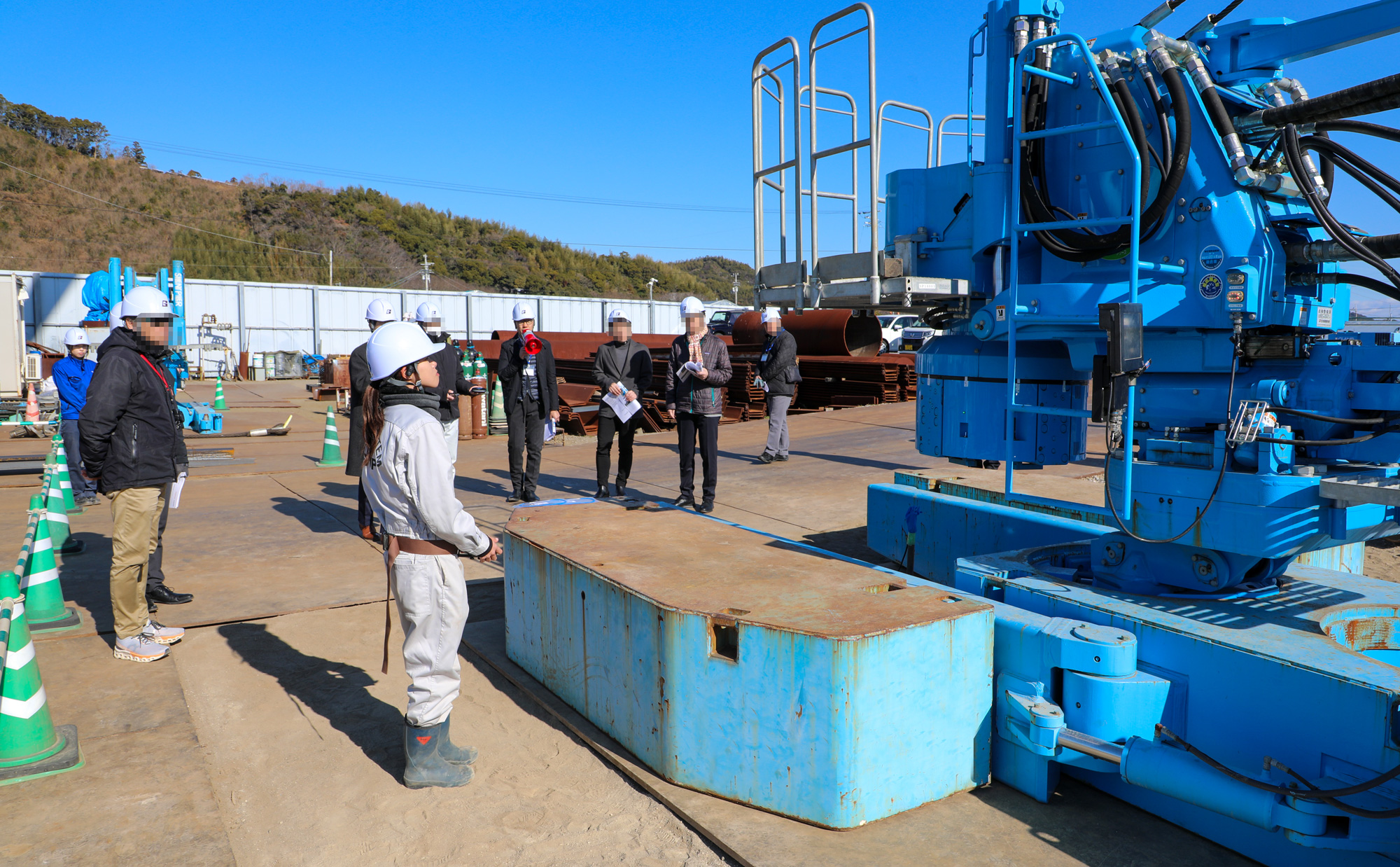
Members of the examination committee inspecting a full-scale experiment (January 2026)
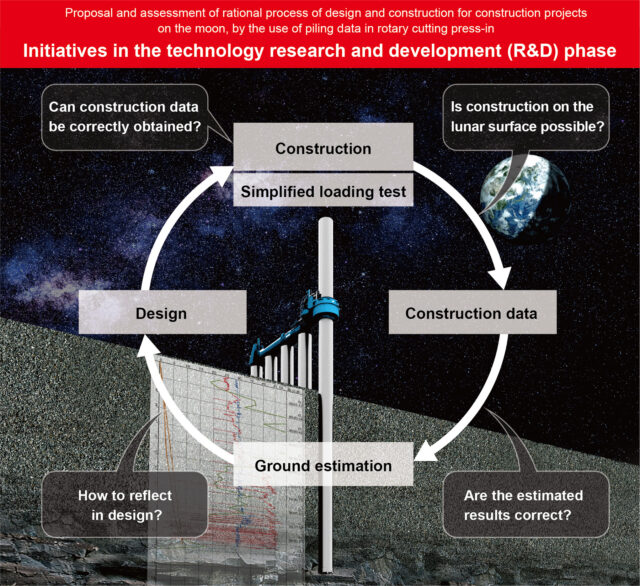
Initiatives in the Technology Research and Development (R&D) Phase
The theme of this phase is “Proposal and assessment of a rational design and construction process for lunar construction using rotary cutting press-in construction data.”
Generally, Earth-based construction projects must proceed in the order of ground survey, design, and construction. By using the PPT System™* of GIKEN, even if survey data is limited, information can be supplemented, and the validity of the design can be assessed with ground information estimated from actual construction data. Additionally, a press-in machine can be used to easily conduct a loading test to measure the bearing capacity of completed piles. In situations like the lunar surface where survey data is extremely sparse, this system allows detailed design alongside survey and construction after a rough design so it should be possible to efficiently ensure structural performance. In outer space, where the volume of materials and equipment transported and the number of processes performed are limited, this will help reduce materials and equipment as well as construction time.
* A system that estimates ground information and performs automatic operation based on various data obtained during press-in construction.
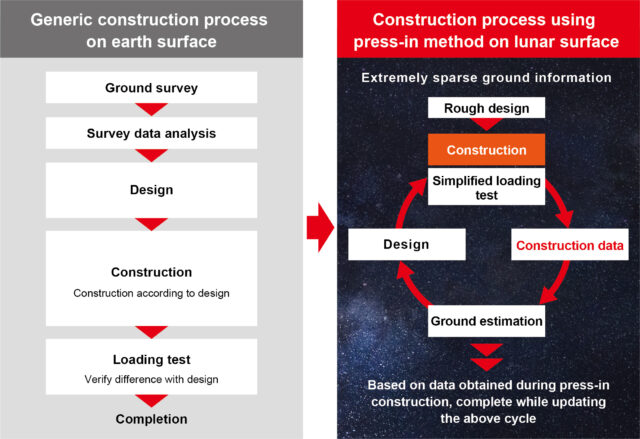
Through this phase, GIKEN will work to verify the feasibility and validity of the construction process using its technology (see diagram below).
Future Outlook
Through FY2025, GIKEN carried out full-scale experiments on the lunar-surface-simulated ground with almost no water content (dense sand), and model experiments on simulated lunar surface sand (FJS-1g). These experiments confirmed the feasibility of piling using the rotary cutting press-in method as well as the possibility of appropriately estimating ground information from construction data, even when conditions such as pile shape and ground depth are different. Furthermore, as a case study, structures that could be effective in the initial stages of lunar surface construction were specified in detail and rough designs assuming limited ground information were attempted.
In FY2026, GIKEN will continue to conduct experiments—including full-scale outdoor experiments using dense sand and model experiments using simulated lunar sand—to solve the remaining issues, such as improving the accuracy of ground information estimation. At the same time, the case study will be further refined, and towards the realisation of a rational construction process on the surface of the moon, GIKEN will show more specifically the ways in which the use of press-in construction data can be effective.
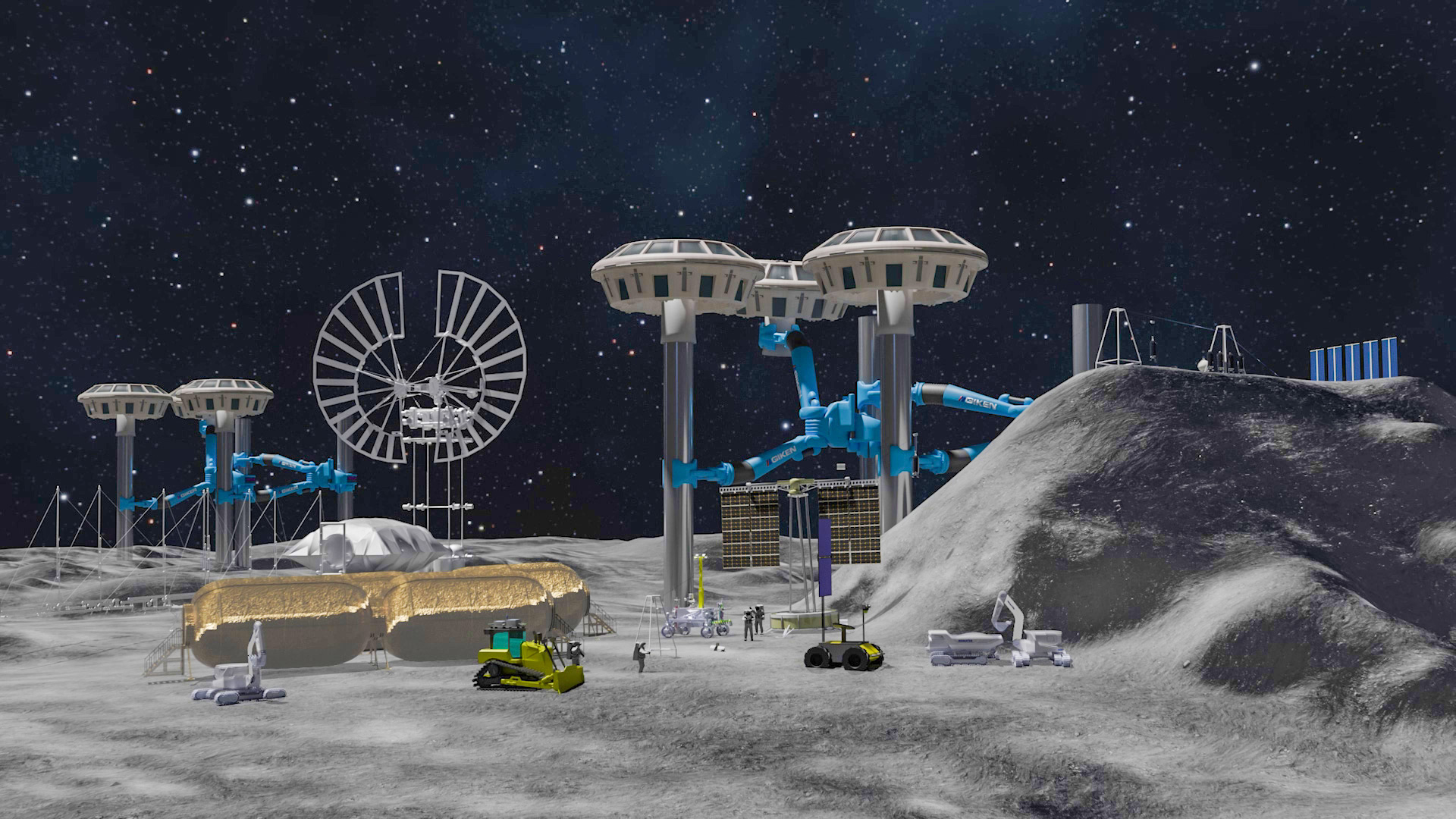
Space Construction Innovation Project (image diagram)
Source: MLIT
■Profile of GIKEN Group
GIKEN developed the SILENT PILER™, the world’s first reaction-based, non-vibratory hydraulic pile driving machine that operates with minimal noise impacts. The GIKEN Group now actively promotes its press-in technology worldwide and contributes to the construction industry by proposing and implementing innovative solutions. The innovative press-in technology provides a unique solution and the adoption of this technology has spread to over 40 nations and regions.
Contact Us