


Two years have passed since the large-scale disaster—centred on the Noto Peninsula—that registered a maximum seismic intensity of 7. Although there were setbacks such as damage from heavy rains during reconstruction, currently, the main recovery work for infrastructure redevelopment has entered its full-scale phase. Amidst the severe impact on traffic and logistics networks, recovery works for ports and roads using the Gyropress Method™—a method for rotary cutting press-in of tubular piles—of GIKEN LTD. is expanding and being highly evaluated at construction sites.
Immediately after the earthquake, the GIKEN Group opened the Noto Reconstruction Support Office in Kanazawa-shi, Ishikawa and was involved in many emergency recovery works, including the road widening work for the Noto-Satoyama Kaido expressway. Since March 2025, engineers responsible for construction planning and progress management were added to the office, further reinforcing the on-site structure.
Through such initiatives, there has been a rapid increase in the adoption of the Gyropress Method™ and the GRB System™ for the reconstruction of roads essential for recovery of the local industry and the redevelopment of harbours and fishing ports. They achieve highly productive and efficiency construction that does not affect ship navigation and road traffic after emergency recovery works.
The GIKEN Group positions disaster prevention and recover as top-priority missions, and will continue to strengthen development and construction capabilities and contribute toward earlier reconstruction and the realisation of safe, secure urban development to respond to natural disasters, which are becoming more severe.
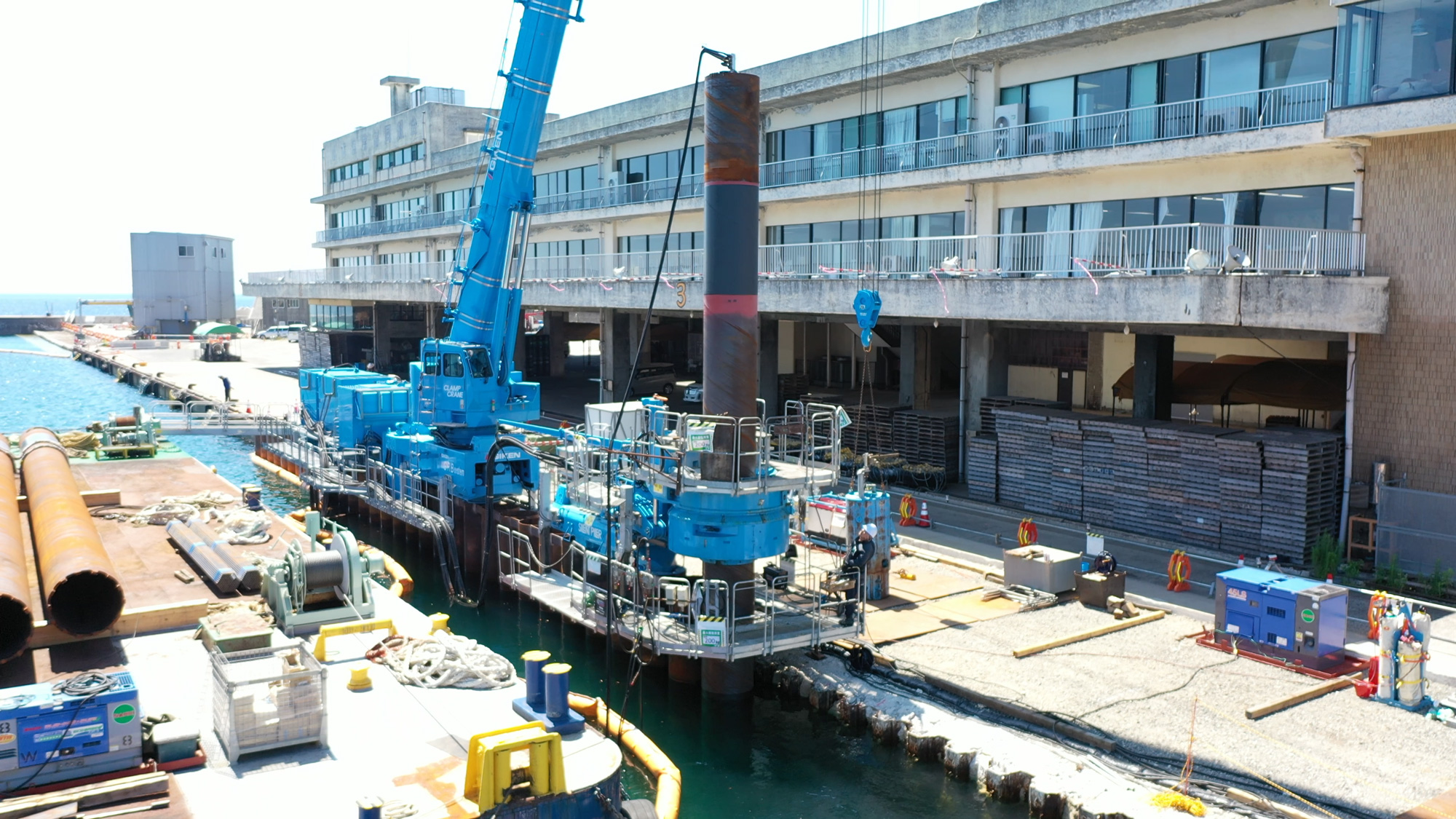
Wharf recovery work at Ogi Port using the Gyropress Method™ and the GRB System™
■Restoration of Port Functions
During the Noto Peninsula Earthquake, ground uplift exceeding 4 m occurred at many fishing ports and harbours, causing widespread difficulties in operations due to insufficient water depth. Many facilities at fishing ports and harbours also suffered subsidence, deformation, and damage due to liquefaction caused by earthquake vibrations. The Noto Peninsula has long flourished as a port region, and the swift restoration of port functions is an essential element for the recovery of the local economy.
Wharf renovation work at Nanao Port
At Nanao Port, a key port that had support both logistics and tourism, levees had collapsed due to earthquake vibrations, and tubular piles were used to construct new levees. Construction at sea is easily affected by weather, tidal heights, and such. Furthermore, the work yard was narrow, and it was also necessary to penetrate a stone debris mound. Approximately two months of work was carried out from August 2025, pressing in 67 tubular piles. Small diameter piles were also installed between piles, creating a structure that can withstand tidal waves even if they strike.
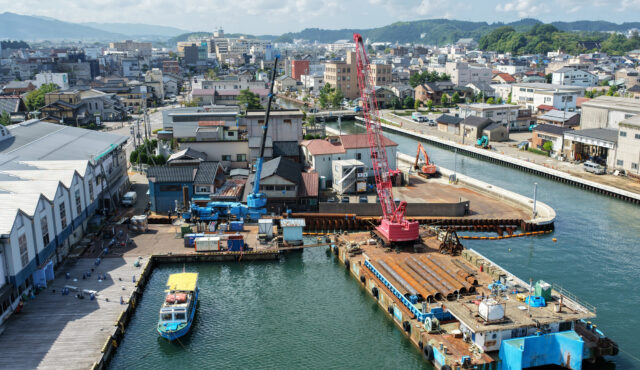
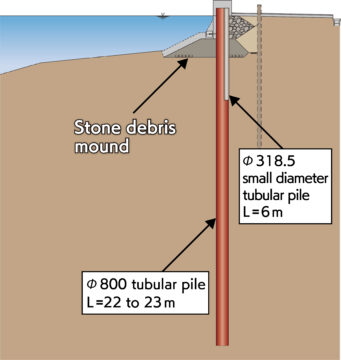
Created by GIKEN LTD. based on data provided
by Toda-Gumi CO., LTD.
Wharf renovation work at Ogi Port
Similarly at Ogi Port (Noto-cho, Ishikawa), which is famous as one of Japan’s top three fishing ports for squid fishing, a new wharf was constructed with tubular piles in front of the existing wharf. To avoid impeding the navigation of large fishing boats, a large barge with a crane was not used. Efforts were also undertaken to maintain port functions by splitting the construction into two phases. Work extending a length of 120 m (111 piles in total) was carried out over five months, from June 2025 and from November 2025. Many local government and construction affiliates participated in the site visit, serving as a springboard toward future adoption and spread of method used.
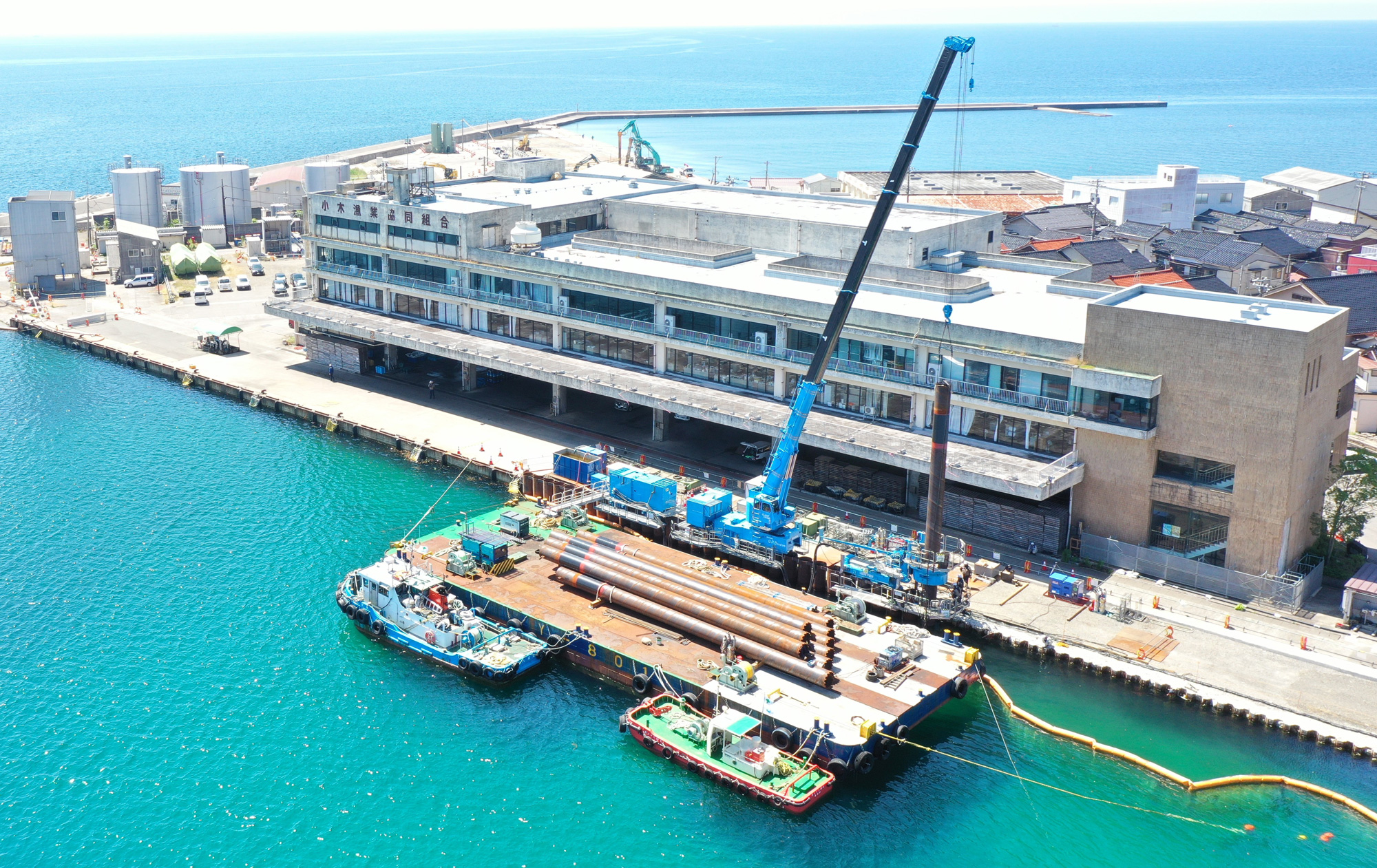
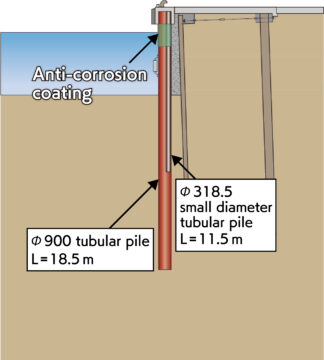
Created by GIKEN LTD. based on data provided
by PENTA-OCEAN CONSTRUCTION CO., LTD.
■Road Closures due to Large-scale Collapse of Earth Fills
During this earthquake, many roads running through mountainous areas were closed due to the large-scale collapse of earth fills, resulting in the isolation of hamlets. Therefore, vulnerable road structures were reviewed, and works are being undertaken to widen road shoulders and suppress landslides. In particular urgent need of such works are the Noto-Satoyama Kaido expressway, a major artery that runs north to south across Ishikawa Prefecture, and the Nouetsu Expressway, an arterial high-standard highway approximately 100 km in length that joins the western part of Toyama Prefecture to the Noto Peninsula.
Noetsu Expressway between Noto Mii Interchange and Noto Satoyama Airport Interchange
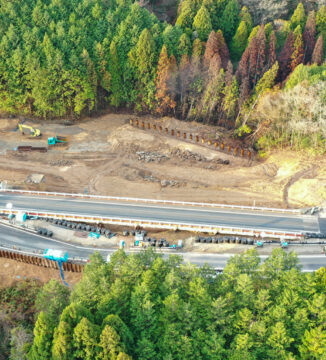
For approximately three months from August 2025, a retaining wall, which is effective in suppressing landslides, was built for recovery at the site of an earth fill collapse. The installation of 32 tubular piles was completed while minimising the access routes and material yards for equipment and materials to maintain alternate two-way traffic using a single lane.
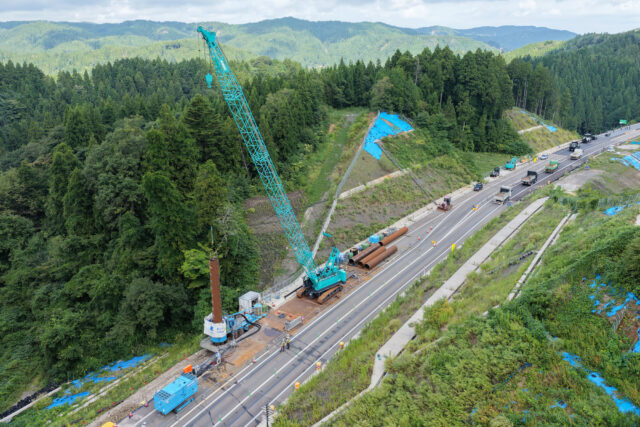
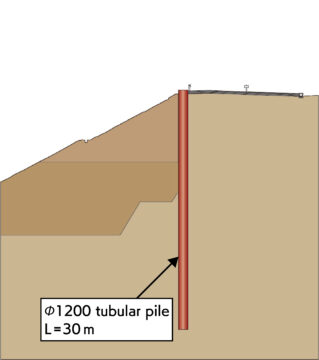
Created by GIKEN LTD. based on data provided
by Sumitomo Mitsui Construction Co., Ltd.
Noto-Satoyama Kaido expressway between Yokota Interchange and Koshinohara Interchange
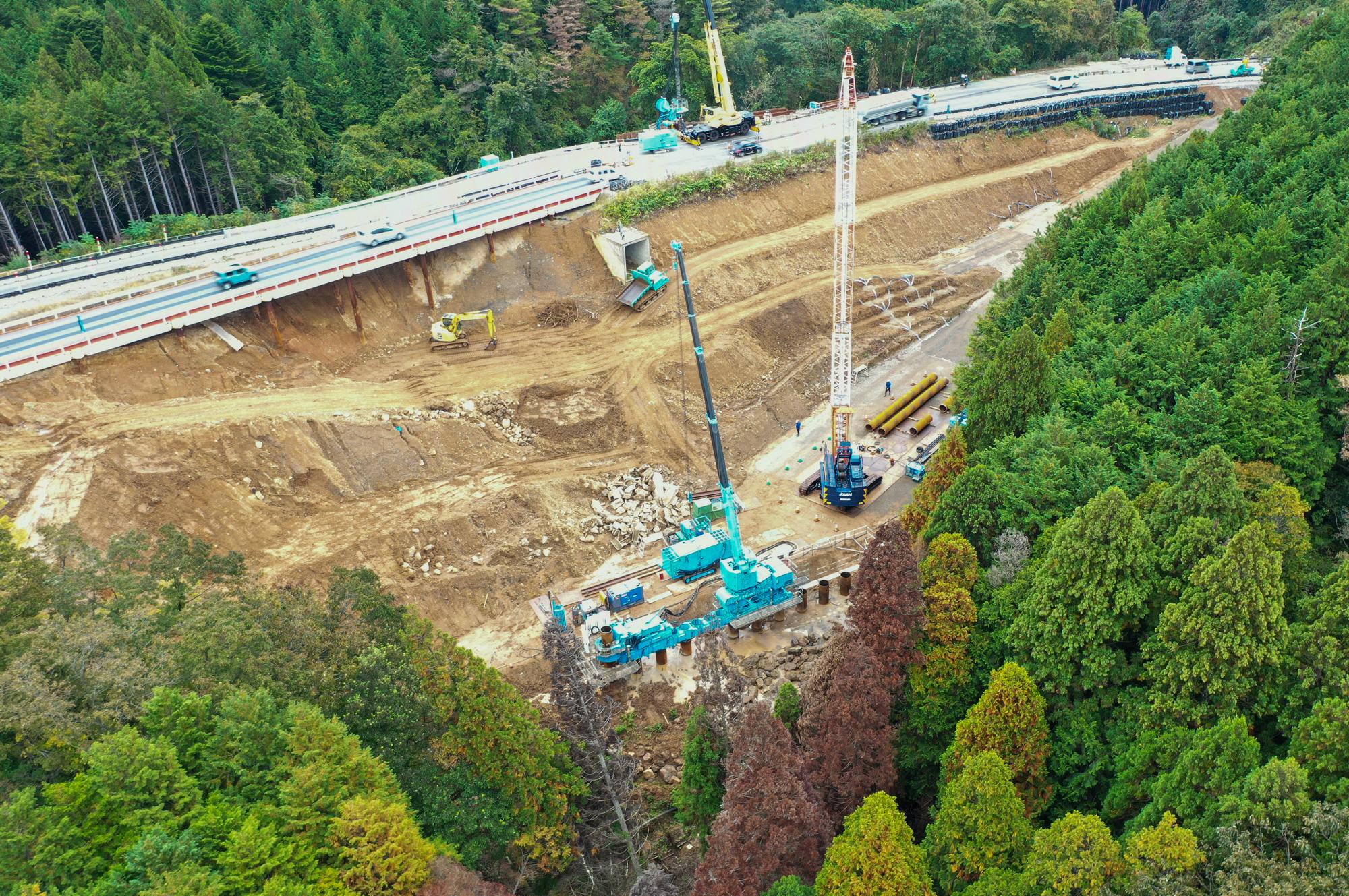
As part of the disaster recovery work at a large-scale collapse site from October to November 2025, installation of landslide control piles has been completed at the section between Yokota Interchange and Koshinohara Interchange on the Noto-Satoyama Kaido expressway. A special attachment was used to carry out a method that skips across piles. Although the piles were being installed on a slope with significant variations in elevation, 20 piles were pressed in at intervals of 2 m.
■Increase in Press-in Construction Projects
Development of infrastructure—such as roads and ports—is lagging behind in the areas from the central part to the tip of the Noto Peninsula, which were heavily affected by the earthquake in particular. It is expected that there will be greater demand in the future for the press-in method, which is essential for road restoration and revetment repair.
Expected projects for Gyropress Method™
in the Hokuriku-Shinetsu region
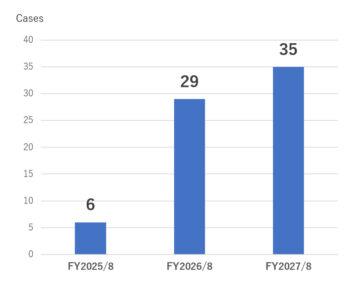
The total number of projects adopting the Gyropress Method™ is expected to reach 29 projects in the Hokuriku-Shinetsu region in this fiscal year (September 2025 to August 2026), which is nearly five times that of the six projects during the previous fiscal year (September 2024 to August 2025).
Furthermore, at this point in time, more than 30 projects are already anticipated in the next fiscal year (September 2026 to August 2027). This trend is common across the entire press-in industry, including users of press-in machines, showing the transition toward a full-scale infrastructure reconstruction phase.
■Profile of GIKEN Group
GIKEN developed the SILENT PILER™, the world’s first reaction-based, non-vibratory hydraulic pile driving machine that operates with minimal noise impacts. The GIKEN Group now actively promotes its press-in technology worldwide and contributes to the construction industry by proposing and implementing innovative solutions. The innovative press-in technology provides a unique solution and the adoption of this technology has spread to over 40 nations and regions.
If you have any questions regarding the news release, please feel free to use the provided form to inquire.
Contact Us